
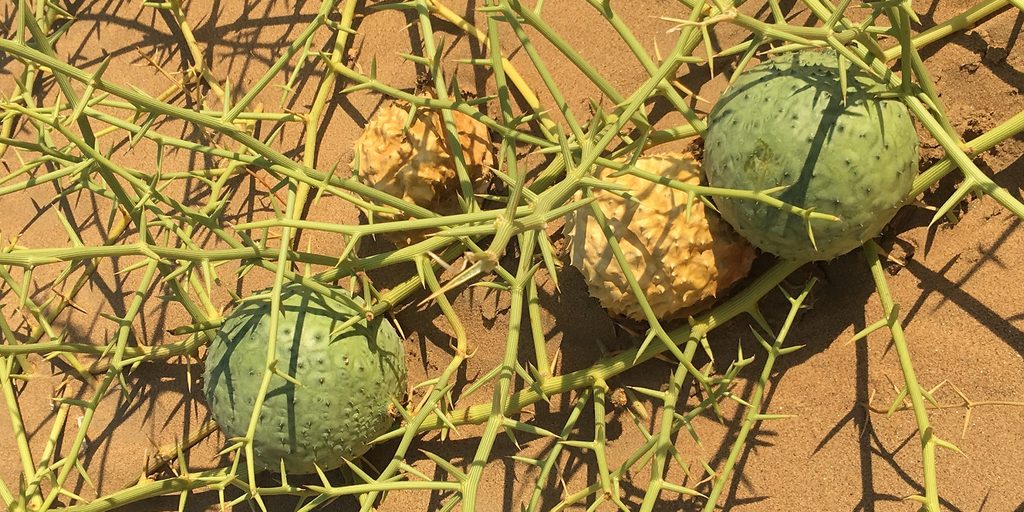
The Namib is one of Africa’s oldest and harshest deserts, and it is where Namib Desert Oils sources its cosmetic ingredients. Stretching along Namibia’s Atlantic coast, it receives almost no rainfall and endures extreme temperatures. Along its bleached Atlantic coastline, a thorny creeper called the !Nara clings to the sand, fruiting for the Topnaar people who have harvested it for millennia. Deep inland, mongongo trees and wild marula drop their nuts onto red earth. For most of the world’s beauty industry, these plants are invisible. Namib Desert Oils is changing that.
Inside Namib Desert Oils: A 100% Namibian Cosmetic Oil Producer
Namib Desert Jojoba (NDJ) is a 100% Namibian company that produces a range of high-quality cosmetic oils exported to Europe, China, and North America. Founded and managed by Oliver Rust and based in Swakopmund, Namibia’s Skeleton Coast, the operation sits at the intersection of desert agriculture and ethical trade. Ingredients used are either grown on remote plantations in desert areas or wild-harvested in unspoilt Namibian bushland, with cold-pressing and filtration carried out at a Namibian production facility to international standards. The company sells both under its own retail brand and as bulk oils to internationally recognised cosmetic houses, operating simultaneously as a B2B ingredient supplier and a finished-product brand.
The Desert Plants: !Nara, Mongongo, Marula and Kalahari Melon
The company’s portfolio draws on four remarkable desert species. The !Nara (Acanthosicyos horridus) is perhaps the most extraordinary endemic to Namibia, it grows in the desert along the Atlantic coastline as a thorny creeper bearing spiky fruits eaten by gemsbok, jackals, hyenas, and porcupines alike. Cold-pressed !Nara seed oil has a very high linoleic acid (omega-6) content, which improves the skin barrier function, reduces inflammation, and regulates sebum production, making it particularly suitable for sensitive and mature skin.
Then there is mongongo (Schinziophyton rautanenii), whose oil carries a rare compound called eleostearic acid. When exposed to UV light, this polymerises to form a protective film in cosmetic products, and mongongo has the highest vitamin E content of all oils. Kalahari Melon (Citrullus lanatus) and Marula (Sclerocarya birrea) round out the range. Marula is rich in vitamins C and E, light in texture and fast-absorbing, and has been used by African women for generations, massaged into hair, scalp, face, and hands, a tradition the company explicitly works to keep alive.
Conservation, Community and FairWild Certification
The social architecture behind Namib Desert Oils is as carefully constructed as its supply chain. In 2017, the company founded the Jojoba for Namibia Trust to combat wealth inequality and establish jojoba plantations and educational harvesting centres in communal areas. The Trust, backed by the Julius Baer Foundation and Swiss NGO Jojoba für Afrika, empowers women in desert areas to run their own jojoba plantations and establish themselves as vendors of prime-quality oil to the European cosmetics industry. The company currently manages 40 hectares of jojoba plantations in Namibia’s Erongo Region, employing 1,500 local women in organic harvesting and production.
Beyond jojoba, the community reach extends to the mongongo harvest. At the Sivara Educational and Harvesting Centre, hundreds of harvesters collect and process mongongo fruit, and the resulting protein powder supplements meals for more than 400 local schoolchildren in partnership with the World Food Programme. On the certification front, Namib Desert Oils achieved FairWild certification in 2024, a standard that verifies wild-collected ingredients are harvested in an ecologically sustainable, socially fair, and commercially responsible manner. Ecocert organic certification has since been awarded for their marula, mongongo, and Kalahari Melon oils.
Why Namib Desert Oils Exhibited at in-Cosmetics Global Paris
At this year’s in-Cosmetics Global event in Paris, there were at least 18 exhibitors of wild-harvested ingredients from across Africa, and Namib Desert Oils was among them. The company’s FairWild certification placed it alongside only two other African exhibitors with that status, a meaningful distinction as European formulators face increasing regulatory and consumer pressure to demonstrate traceable, ethical sourcing. The show offered direct access to the R&D and procurement teams at major beauty houses looking to incorporate Africa’s botanical heritage into the next generation of skincare serums and hair treatments. For Namib Desert Oils, it was less a debut than a statement of arrival.
The story of Namib Desert Oils demonstrates a broader principle: Africa’s biodiversity, when properly valued and sustainably managed, is both an ecological treasure and an economic asset. The global shift toward natural, traceable beauty ingredients is not just a trend but an opportunity to build systems in which conservation and community development reinforce one another.
By Naomi June
Originally posted on the website of the African Wildlife Economy Institute here.