
Conservation, local sourcing and healthy eating come together in Wimbledon’s 2026 menu.
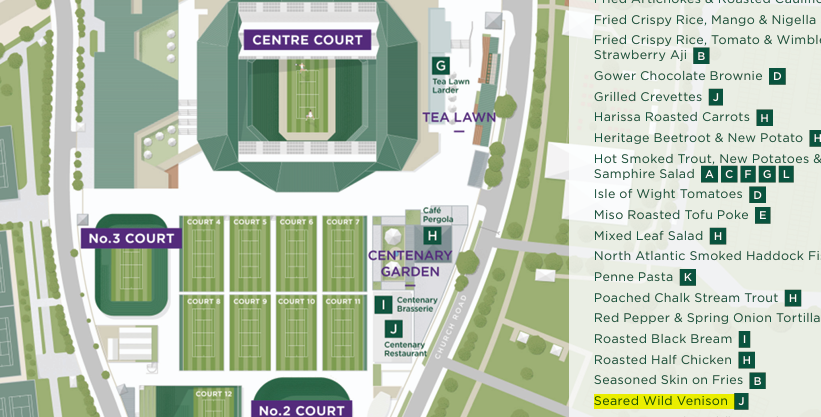
Not far from Centre Court, diners at the Centenary Restaurant can now enjoy seared wild venison. According to Wimbledon’s own announcements, Executive Chef Bryn Williams — himself a farmer — champions locally sourced, seasonal ingredients. He highlights venison as a versatile, protein-dense, lean meat that many diners now prefer over beef. The source? The wild red and fallow deer of London’s Royal Parks.
As reported in The Telegraph and elsewhere, Wimbledon’s switch from beef to venison isn’t just about taste and quality. It’s part of the tournament’s broader commitment to reach net zero carbon emissions by 2030. Venison production generally has a lower environmental footprint than beef, particularly when it comes from managed wild herds rather than intensive farming.
Chef Williams has noted that serving venison is not only healthier for diners but also helps manage deer populations that, without intervention, could cause significant ecological pressure in enclosed spaces.
Eating venison at Wimbledon exemplifies a choice that benefits the consumer, the climate, and local wildlife management.
Sourcing from London’s Royal Parks
The venison comes from the free-roaming herds in Richmond Park and Bushy Park, managed by The Royal Parks. These historic herds (red and fallow deer) have lived in the parks for centuries — since the time of Charles I and Henry VIII.
The Royal Parks actively manage the populations for welfare reasons. As they explain on their website:
“Deer populations are actively managed to keep herds at a sustainable size, and to prevent overcrowding. If the herd size was not managed, food would become scarce, and more animals would ultimately suffer… Without population control there would be other welfare issues such as low body fat, malnutrition and high incidence of death from exposure to cold in winter.”
Harvesting takes place twice a year — primarily females in November and males in February — after the parks close to the public. It is carried out humanely by trained professionals following the guidance of the British Deer Society. The venison is sold to cover the costs of winter feed and wildlife officers; The Royal Parks make no profit from it.
Reports suggest roughly 200–300 deer are harvesting annually across the two parks (with the majority from Richmond), helping maintain healthy herds of around 630 in Richmond Park and over 300 in Bushy Park.
A Sustainable Win
Wimbledon’s decision to feature this local, wild venison is smart on multiple levels. It supports excellent British produce, reduces reliance on higher-impact meats, helps fund deer management in London’s green spaces, and gives spectators a high-quality, lower-carbon dining option.
In a tournament famous for tradition and precision, this menu choice feels refreshingly modern — and genuinely thoughtful.
Game meat. Set. Match.
By Francis Vorhies
(Image from Wimbledon’s Non-Gluten Dietaries Map)